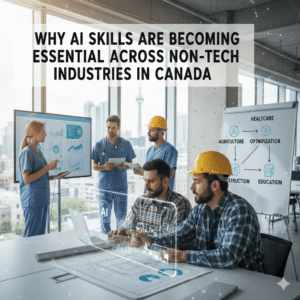

Introduction: AI Is Reshaping Canadian Finance
Canada’s financial services sector has always been a cornerstone of the national economy. From major banks and credit unions to fintech startups and insurance providers, the industry plays a critical role in economic stability and innovation.
Today, Artificial Intelligence (AI) is fundamentally transforming how financial institutions operate. But the real driver behind this transformation is not just technology — it’s the AI professionals designing, deploying, and managing these intelligent systems. As demand for innovation accelerates, AI talent is becoming one of the most valuable assets in Canada’s financial ecosystem.
1. Smarter Risk Management and Fraud Detection
Financial institutions handle massive volumes of transactions daily. Traditional fraud detection systems often rely on static rules, which can miss sophisticated threats.
AI professionals are building advanced machine learning models that:
-
Detect suspicious transaction patterns in real time
-
Reduce false positives
-
Adapt to evolving fraud techniques
-
Improve compliance monitoring
By leveraging AI talent, Canadian banks and fintech firms can significantly enhance security while maintaining smooth customer experiences.
2. Personalized Banking Experiences
Modern customers expect personalized, digital-first financial services. AI specialists are enabling financial institutions to deliver customized solutions at scale.
AI-driven personalization includes:
-
Tailored product recommendations
-
Predictive financial planning insights
-
Intelligent chatbots and virtual assistants
-
Real-time credit scoring
These innovations improve customer satisfaction and retention. Skilled AI engineers and data scientists are essential for designing systems that analyze behavior and respond intelligently.
3. Data-Driven Decision Making
Financial services generate enormous amounts of structured and unstructured data. AI professionals transform this data into actionable insights.
Key contributions of AI talent include:
-
Forecasting market trends
-
Optimizing lending strategies
-
Enhancing portfolio management
-
Improving operational efficiency
Instead of relying solely on historical analysis, AI enables predictive modeling that strengthens strategic decision-making across Canadian financial institutions.
4. The Rise of FinTech and AI-Driven Startups
Canada’s fintech ecosystem is expanding rapidly. Startups are using AI to challenge traditional financial models by offering:
-
Automated investment platforms
-
AI-powered lending systems
-
Blockchain-integrated solutions
-
Intelligent payment processing
These companies depend heavily on AI engineers, machine learning specialists, and MLOps professionals. Recruitment strategies must evolve to secure talent capable of building scalable, secure financial technologies.
5. Regulatory Compliance and Ethical AI
The financial sector is highly regulated. AI professionals in Canada must understand not only algorithms but also compliance frameworks and ethical considerations.
AI talent supports:
-
Transparent model development
-
Bias detection and mitigation
-
Explainable AI systems
-
Secure data governance
As regulatory scrutiny increases, professionals who combine technical expertise with regulatory awareness become especially valuable.
6. Operational Efficiency Through Automation
AI is reducing operational costs across financial institutions by automating repetitive and time-consuming processes.
Examples include:
-
Automated document verification
-
Intelligent claims processing
-
AI-powered customer onboarding
-
Robotic process automation integrated with machine learning
These advancements allow organizations to focus human expertise on higher-value tasks, increasing overall efficiency and productivity.
7. Talent Shortages and Competitive Hiring
Despite Canada’s strong AI research foundation, financial institutions face challenges in securing experienced AI professionals.
Common hiring challenges include:
-
Intense competition with tech firms
-
High salary expectations
-
Limited senior-level AI specialists
-
Fast-moving hiring cycles
This makes AI recruitment in Canada’s financial sector increasingly strategic. Organizations must move quickly and offer compelling value propositions to attract top candidates.
8. The Strategic Role of Recruitment Partners
Because AI hiring in financial services requires both technical and industry-specific expertise, many organizations partner with specialized recruitment agencies like Pivot Search Group.
Recruitment partners help by:
-
Identifying AI professionals with financial domain knowledge
-
Reducing time-to-hire
-
Accessing passive candidates
-
Aligning hiring with long-term digital transformation goals
Strategic recruitment ensures financial institutions secure the talent needed to remain competitive in a rapidly evolving market.
9. Preparing for the Future of AI in Finance
The transformation of Canada’s financial services sector is far from complete. Emerging trends include:
-
Generative AI for financial analysis
-
AI-powered wealth management
-
Advanced cybersecurity intelligence
-
Real-time predictive analytics
As these technologies mature, demand for AI talent will continue to grow. Institutions that invest in strong AI teams today will lead tomorrow’s financial innovation.
Conclusion: AI Talent Is Powering the Future of Canadian Finance
Artificial Intelligence is redefining Canada’s financial services landscape. From fraud detection and personalization to compliance and automation, AI-driven innovation depends entirely on skilled professionals.
AI talent is not just supporting the financial sector — it is transforming it. Organizations that prioritize strategic AI recruitment, workforce development, and long-term talent retention will shape the future of Canadian finance.
For companies seeking to strengthen their AI capabilities, partnering with experienced recruitment specialists like Pivot Search Group can make the difference between keeping pace and leading the market.