Introduction: Automation Is Reshaping Canada’s Workforce at Every Level
Automation is no longer a future trend — it is a present reality transforming the Canadian economy. From AI-powered analytics and robotic process automation (RPA) to machine learning systems and intelligent workflows, businesses across Canada are integrating automation into daily operations.
But automation is not simply about replacing tasks. It is about redefining how value is created within organizations. As companies adopt automated systems, the skills they seek in employees are evolving dramatically.
Canadian employers are no longer focused solely on traditional qualifications or years of experience. Instead, they are prioritizing adaptability, digital fluency, analytical thinking, and strategic insight. Automation is shifting hiring priorities from routine execution to higher-level problem-solving.
Understanding how automation changes skill demand is critical for both employers shaping hiring strategies and professionals planning their careers.
1. From Manual Execution to Strategic Thinking
Historically, many roles across industries relied heavily on repetitive, manual processes. Administrative tasks, data entry, reporting, scheduling, inventory management, and even elements of financial processing were handled manually.
Today, automation handles these tasks with greater speed and accuracy. As a result, Canadian employers are shifting focus away from routine task performance toward strategic contribution.
Employees are now expected to:
-
Interpret automated outputs rather than generate raw data
-
Identify patterns and inefficiencies
-
Recommend process improvements
-
Support data-driven decision-making
The emphasis has moved from “doing the task” to “improving the system.” This shift elevates the importance of analytical and critical thinking skills across all industries.
2. Digital Literacy Is Becoming Foundational Across Roles
Digital literacy is no longer optional, even outside of technology roles. Automation tools, cloud platforms, AI-powered dashboards, and workflow systems are embedded into operations across finance, healthcare, retail, logistics, manufacturing, and professional services.
Employers increasingly seek professionals who are comfortable working with:
-
Workflow automation platforms
-
CRM and ERP systems
-
Data visualization tools
-
AI-assisted productivity software
-
Cloud-based collaboration tools
Employees who resist digital systems struggle to remain competitive. Those who embrace and understand automation tools contribute significantly more value.
3. Data Literacy Is a Core Competency in the Automated Workplace
Automation generates large volumes of real-time data. However, data has limited value without interpretation.
Canadian employers now prioritize professionals who can:
-
Read dashboards and performance reports
-
Understand KPIs and operational metrics
-
Identify trends and anomalies
-
Translate data insights into business decisions
Data literacy is no longer limited to analysts. Managers, HR professionals, marketers, operations leaders, and even frontline employees benefit from the ability to interpret data effectively.
Automation creates information — humans must create insight.
4. Hybrid Skill Sets Are Replacing Single-Domain Expertise
Automation blurs the boundaries between technical and non-technical roles. As systems become integrated across departments, employers seek candidates who combine domain expertise with technological awareness.
Examples include:
-
HR managers who understand HR analytics platforms
-
Finance professionals comfortable with AI-based forecasting tools
-
Supply chain managers who leverage predictive modeling
-
Marketing specialists using automated customer segmentation
This rise of hybrid roles means Canadian employers are less interested in siloed skill sets and more interested in cross-functional capability.
5. Adaptability and Continuous Learning Drive Employability
Automation evolves rapidly. Tools adopted today may be outdated within a few years. Employers now prioritize professionals who demonstrate:
-
Willingness to upskill
-
Curiosity about new technologies
-
Flexibility in changing workflows
-
Comfort with experimentation
Adaptability has become a critical hiring factor. Professionals who embrace change rather than resist it become long-term assets.
Organizations are investing more in training, but they also expect employees to take ownership of their development.
6. Soft Skills Are Gaining Strategic Importance
Ironically, as automation advances, human skills become even more valuable.
While machines excel at processing information and executing rules, they cannot replicate:
-
Leadership
-
Emotional intelligence
-
Collaboration
-
Creativity
-
Ethical judgment
Canadian employers increasingly emphasize these capabilities because automated systems still require human oversight, direction, and innovation.
Teams that combine technical efficiency with strong communication and leadership outperform those relying solely on automation.
7. Leadership Expectations Are Evolving in the Age of Automation
Automation does not only affect entry-level roles. Leadership requirements are shifting significantly.
Modern leaders must:
-
Understand automation strategy
-
Evaluate technology investments
-
Align automation initiatives with business goals
-
Manage hybrid human-machine teams
-
Lead organizational change
Executives and managers are expected to possess at least foundational knowledge of AI, data systems, and automation tools to guide digital transformation effectively.
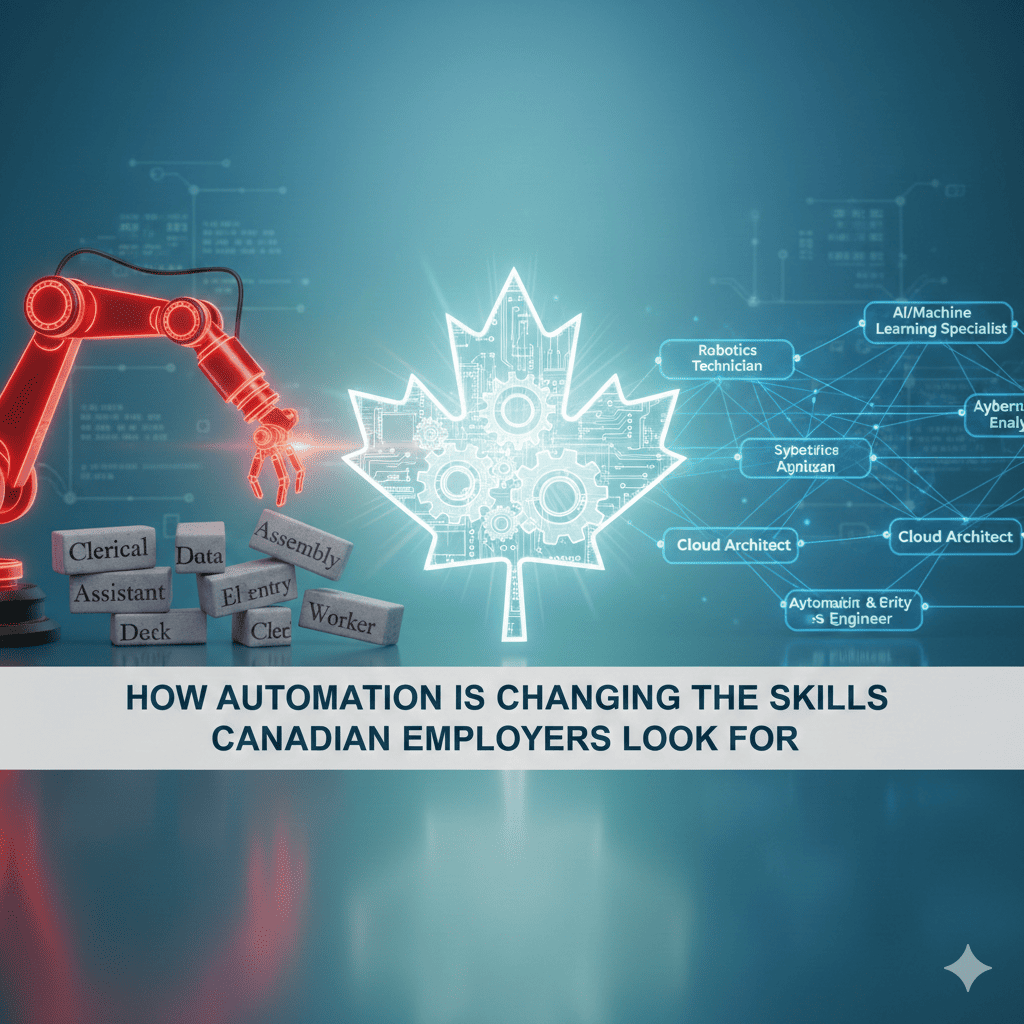
8. Automation Is Creating New Roles and Career Paths
Contrary to common fears, automation is not simply eliminating jobs. It is reshaping and creating new roles.
Emerging positions include:
-
Automation specialists
-
AI implementation managers
-
Data analysts
-
Process optimization consultants
-
Digital transformation leads
-
MLOps engineers
Canadian employers are actively recruiting talent for roles that did not exist a decade ago. Automation is shifting the workforce toward higher-value, innovation-driven careers.
9. Recruitment Strategies Must Adapt to Skill Shifts
As skill requirements evolve, recruitment strategies must also change.
Traditional job descriptions that focus solely on years of experience or static qualifications are no longer effective. Employers must assess:
-
Learning agility
-
Technical adaptability
-
Problem-solving ability
-
Cultural alignment with innovation
Recruitment partners play an important role in identifying candidates who possess both the technical readiness and the mindset required for automated environments.
10. The Long-Term Impact on Canada’s Workforce
Automation is not a temporary shift — it represents a long-term transformation of Canada’s economy.
Industries that invest early in automation skills will gain:
-
Increased productivity
-
Operational efficiency
-
Competitive advantage
-
Stronger innovation capacity
Professionals who proactively develop automation-friendly skill sets will remain resilient in an evolving job market.
Canada’s workforce is not shrinking — it is becoming more intelligent, data-driven, and strategically oriented.
Conclusion: Automation Elevates Human Value
Automation is often misunderstood as a threat to employment. In reality, it is redefining what makes employees valuable.
Canadian employers are no longer seeking task executors. They are seeking thinkers, innovators, collaborators, and adaptable professionals who can work effectively alongside intelligent systems.
The future of work in Canada belongs to those who combine human insight with technological fluency.
Automation does not eliminate opportunity — it elevates expectations.