Introduction: AI Is No Longer Just for Tech Companies
Artificial Intelligence was once seen as the domain of tech giants and software startups. Today, that perception has completely changed. Across Canada, non-tech industries are rapidly integrating AI into daily operations, customer experiences, and strategic decision-making.
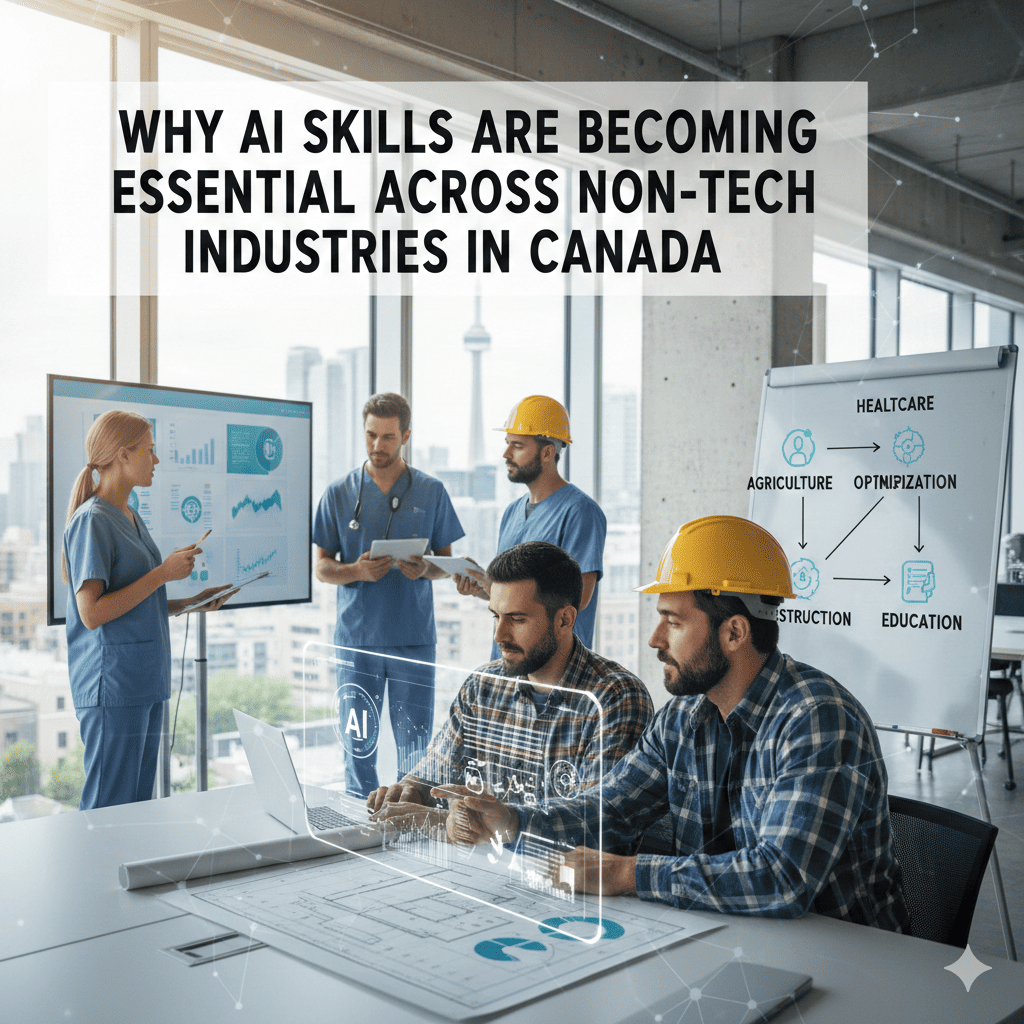
From healthcare and finance to retail, manufacturing, logistics, and even agriculture, AI is becoming a core driver of efficiency and innovation. As a result, AI skills are no longer limited to technology firms — they are becoming essential across nearly every sector of the Canadian economy.
For employers, this shift is transforming recruitment priorities. For professionals, it is redefining career paths.
1. Healthcare: Smarter Diagnosis and Operational Efficiency
Canada’s healthcare sector is leveraging AI to improve patient outcomes and streamline processes. AI professionals are building systems that assist with:
-
Diagnostic imaging analysis
-
Predictive patient risk assessment
-
Hospital resource optimization
-
Automated documentation and reporting
Hospitals and healthcare organizations now require data scientists, machine learning engineers, and AI specialists to support these initiatives. AI skills are becoming critical to modern healthcare operations.
2. Finance: Intelligent Risk and Fraud Management
While finance has always been data-driven, AI has significantly elevated its capabilities. Canadian banks, insurance providers, and fintech companies rely on AI professionals to:
-
Detect fraud in real time
-
Improve credit scoring models
-
Forecast market trends
-
Personalize financial services
Even traditional financial institutions that once relied on manual processes now prioritize AI hiring as part of their digital transformation strategies.
3. Retail and E-Commerce: Personalization at Scale
Retailers across Canada are using AI to enhance customer engagement and optimize inventory management. AI-powered systems support:
-
Product recommendation engines
-
Demand forecasting
-
Dynamic pricing strategies
-
Customer behavior analysis
Retail is no longer just about physical stores — it is about data-driven experiences. AI skills are essential to remain competitive in Canada’s evolving retail market.
4. Manufacturing: Predictive Maintenance and Automation
Canada’s manufacturing industry is undergoing a smart transformation. AI professionals are enabling predictive maintenance systems that reduce downtime and lower operational costs.
AI in manufacturing supports:
-
Equipment failure prediction
-
Supply chain optimization
-
Quality control automation
-
Robotics and intelligent production systems
Companies that invest in AI talent are achieving higher productivity and improved operational resilience.
5. Logistics and Supply Chain: Data-Driven Efficiency
Supply chain disruptions have highlighted the need for smarter logistics management. AI is helping Canadian organizations:
-
Forecast demand fluctuations
-
Optimize delivery routes
-
Manage warehouse automation
-
Improve inventory accuracy
AI professionals play a key role in designing these intelligent systems, making AI expertise critical even in traditionally non-technical industries.
6. Agriculture and Natural Resources: Smart Innovation
Even agriculture and natural resource sectors in Canada are leveraging AI. Applications include:
-
Crop yield prediction
-
Climate pattern analysis
-
Resource optimization
-
Automated monitoring systems
AI skills are becoming essential in industries that were once considered purely manual or operational.
7. Data Literacy Is Becoming a Universal Requirement
Beyond hiring specialized AI engineers, non-tech industries are also seeking employees with foundational AI and data literacy.
Employers increasingly value professionals who can:
-
Interpret AI-generated insights
-
Work alongside data teams
-
Understand automation tools
-
Make data-informed decisions
This shift means AI awareness is becoming a core skill set across management, operations, and strategic roles.
8. The Growing Demand for AI Recruitment in Non-Tech Sectors
As AI adoption expands beyond traditional tech firms, recruitment strategies must evolve. Companies in healthcare, retail, manufacturing, and other industries now compete for the same AI talent as software companies.
This creates new challenges:
-
Intense competition for skilled professionals
-
Need for industry-specific AI knowledge
-
Balancing technical expertise with business understanding
-
Faster hiring cycles
Specialized recruitment support becomes critical to secure AI professionals who can adapt to non-tech industry environments.
9. Strategic Hiring for Long-Term Competitiveness
AI is no longer a luxury innovation — it is a strategic necessity. Non-tech industries that fail to integrate AI skills risk falling behind competitors who leverage automation, predictive analytics, and data-driven decision-making.
By investing in AI talent today, Canadian organizations across all sectors position themselves for:
-
Improved efficiency
-
Enhanced customer experiences
-
Stronger competitive advantage
-
Sustainable long-term growth
Conclusion: AI Skills Are the Future of Every Industry
Artificial Intelligence is transforming Canada’s economy far beyond the tech sector. From healthcare and finance to manufacturing and agriculture, AI skills are becoming essential components of modern business strategy.
For employers, this means rethinking hiring priorities and investing in AI recruitment. For professionals, it means developing skills that will remain valuable across industries.
In today’s market, AI expertise is no longer optional — it is foundational to growth, innovation, and competitiveness in Canada’s evolving economy.